Anterior Drawing without drawing
Mathematics
10 to 12 years
60 min.
30 to 35 girls
WHAT IT IS ABOUT
Discover how an image travels using zeros and ones.
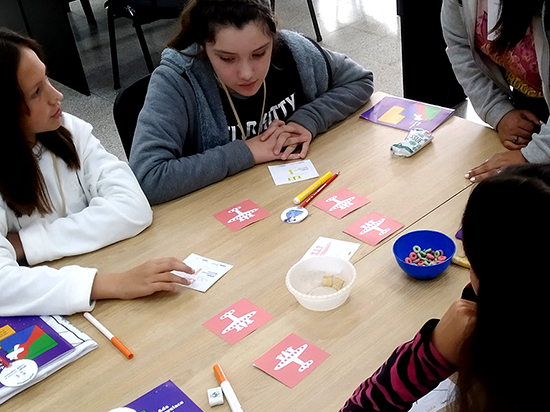
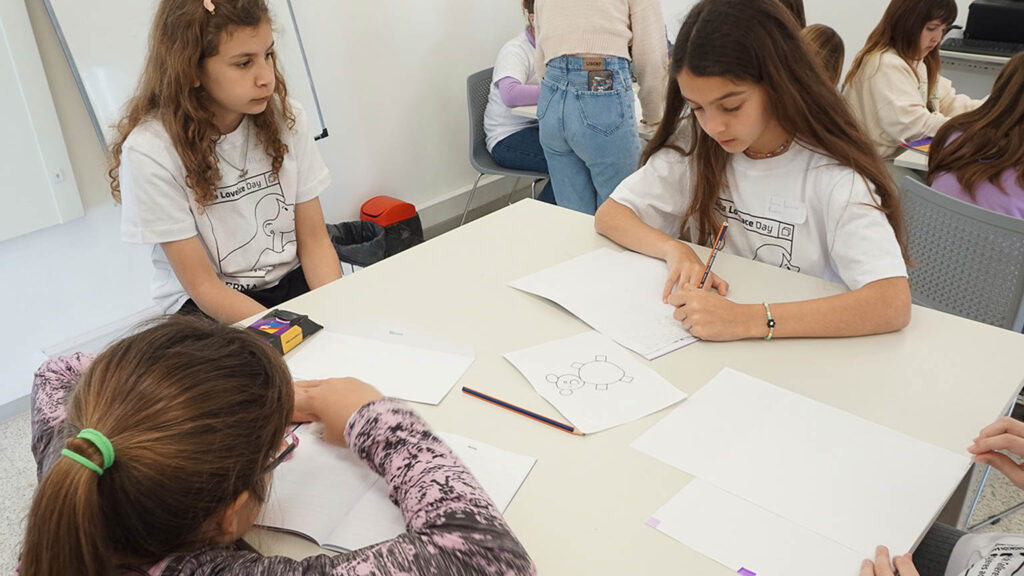
In this activity, the girls explore how it is possible to send photos from one place to another through a mobile phone. Starting from the game Guess Who?, they discover strategies to ask better questions and reduce options more efficiently. Then, they relate that process to the digital transmission of images, understanding how a photo can be transformed into binary information that a computer can interpret.
Information for host sites:
To download the materials, host sites must log in

If you want to implement this proposal in your educational institution, write to us to receive guidance and the complete material: worksheets, step-by-step guide and video tutorial.
You can also register as a host site and be part of this network that grows every year throughout Latin America!
Department of Mathematics. Faculty of Chemical Engineering.
Universidad Nacional del Litoral. Santa Fe, Argentina.
Marcelo Actis
PhD in Mathematics (UNL). Assistant Professor at the Department of Mathematics of the Faculty of Chemical Engineering at UNL. Assistant Researcher at CONICET.
Andrea Bergesio
PhD from UBA, Mathematical Sciences area. Assistant Professor at the Department of Mathematics of the Faculty of Chemical Engineering at UNL.
Tomás Gerbazoni
María José Llop
Bachelor in Mathematics (UNL). Teaching assistant at the Department of Mathematics of the Faculty of Chemical Engineering at Universidad Nacional del Litoral. Doctoral fellow at CONICET.
Mariel Lovatto
Master in Statistics (UNR). Teaching assistant at the Department of Mathematics of the Faculty of Chemical Engineering at Universidad Nacional del Litoral. Doctoral fellow at CONICET.
Pablo Quijano
Mara Pérez
Brenda Rivera
Bachelor in Visual Communication Design (FADU-UNL). Student at the 42 Madrid school, Fundación Telefónica. Part of extraPola, a mathematics outreach collective (FIQ-UNL). Passionate about the intersection between technology, design and scientific communication.
Agustín Riveros
Student of the Bachelor’s degrees in Applied Mathematics and Data Science. Part of ExtraPola, with whom he seeks to communicate mathematical concepts to the general public in a creative way.
Uma Tedesco
Teo Valencia
Itatí Zocola
Bachelor in Applied Mathematics. Doctoral fellow in Mathematics at CONICET. Teacher at the Department of Mathematics (FIQ-UNL). She researches stabilized methods for dominant advection problems. Part of extraPola, she takes part in mathematics outreach and extension projects with a gender perspective.