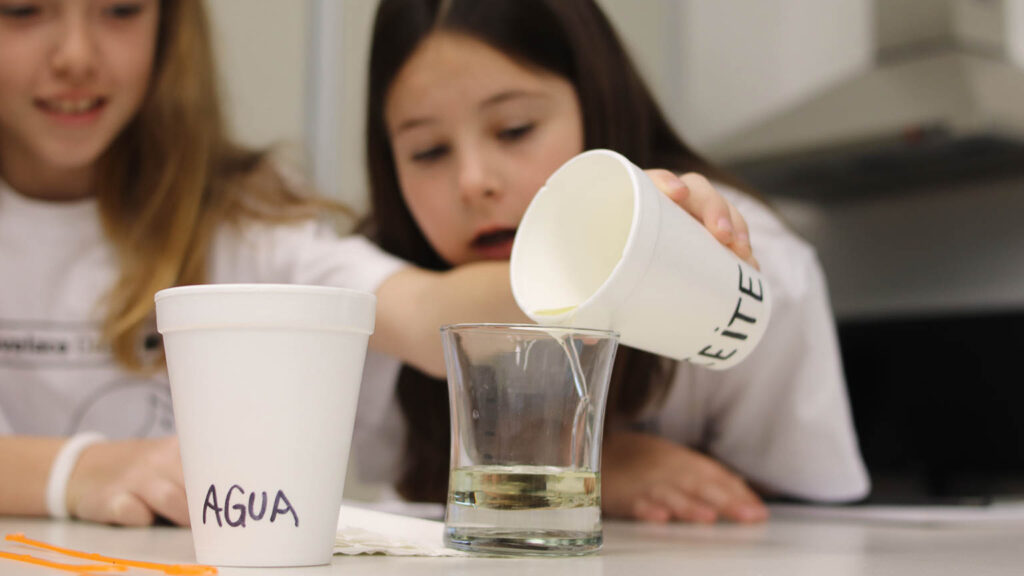
In this activity, the girls help Arboris, a social robot, to solve new challenges to learn how to plant and care for native trees. Through experiments, observation and data recording, they discover what conditions a plant needs to grow well and how that information helps to train an artificial intelligence. Then, they transform that data into clear instructions so that Arboris can make correct decisions.
Information for host sites: To download the materials, host sites must log in
Previous
Next
Are you interested in this activity?
If you want to implement this proposal in your educational institution, write to us to receive guidance and the complete material: worksheets, step-by-step guide and video tutorial.
You can also register as a host site and be part of this network that grows every year throughout Latin America!
Romina Biotti Also known as GaBiOTa. Professor of Chemistry (FIQ-UNL), Specialist in Natural Sciences Education (Universidad de San Andrés) and Master’s student in University Teaching (FHUC-UNL). She plays with soil in the Laboratory of Plant and Soil Chemistry (FIQ-UNL). Teacher at the Science Laboratory of the UNL Primary School, a creative space where girls and boys learn science in a playful and experimental way. Passionate about sowing scientific vocations in girls and adolescents through chemistry, technology and outreach.
Eve Araujo Sola Bachelor in Biodiversity (FHUC-UNL) and PhD student in Biological Sciences (FBCB-UNL). A FIQ girl (UNL), teaching assistant at the Microbiology Laboratory. Fascinated by life in all its diversity, from the invisible to the imposing. Guided by curiosity, my mission is to spread the love of science and nature to girls and adolescents, even though the little lizards have not thanked me yet.
Brenda Rivera Bachelor in Visual Communication Design (FADU-UNL). Student at the 42 Madrid school, Fundación Telefónica. Part of extraPola, a mathematics outreach collective (FIQ-UNL). Passionate about the intersection between technology, design and scientific communication.