What are we watching today? Netflix already decided

Mathematics and physics

Area

Mathematics / Statistics

Age

10 to 12 years

Duration

60 min.

Participants

30 to 35 girls

WHAT IT IS ABOUT

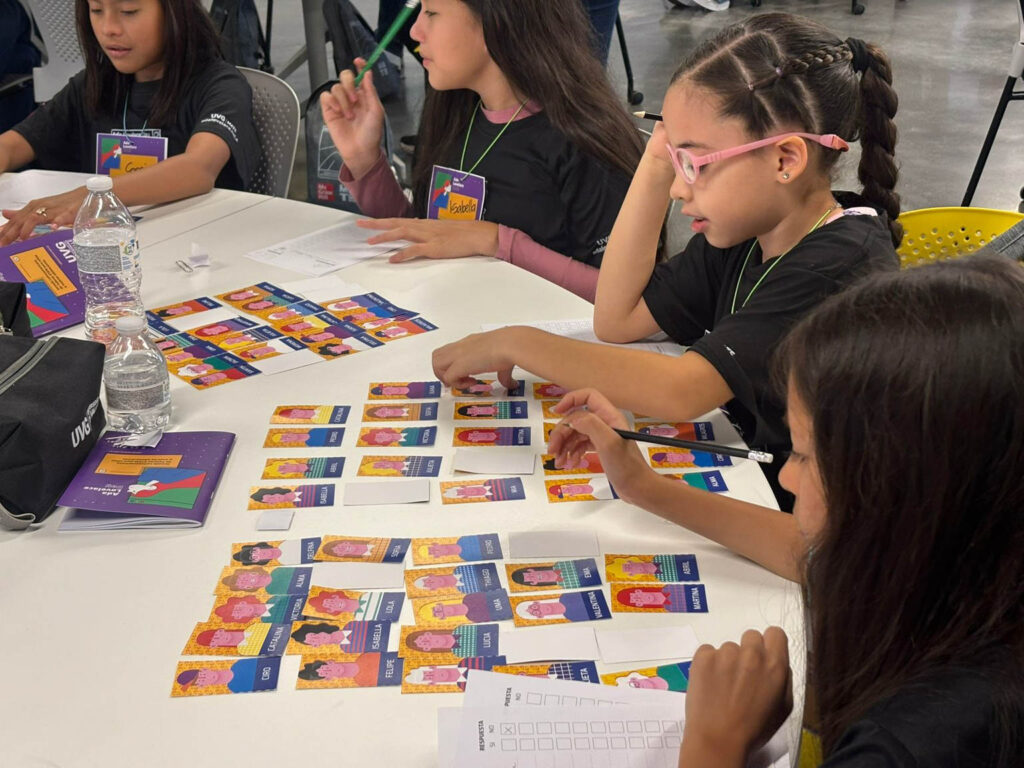
A playful activity to explore how recommendation systems work based on data.

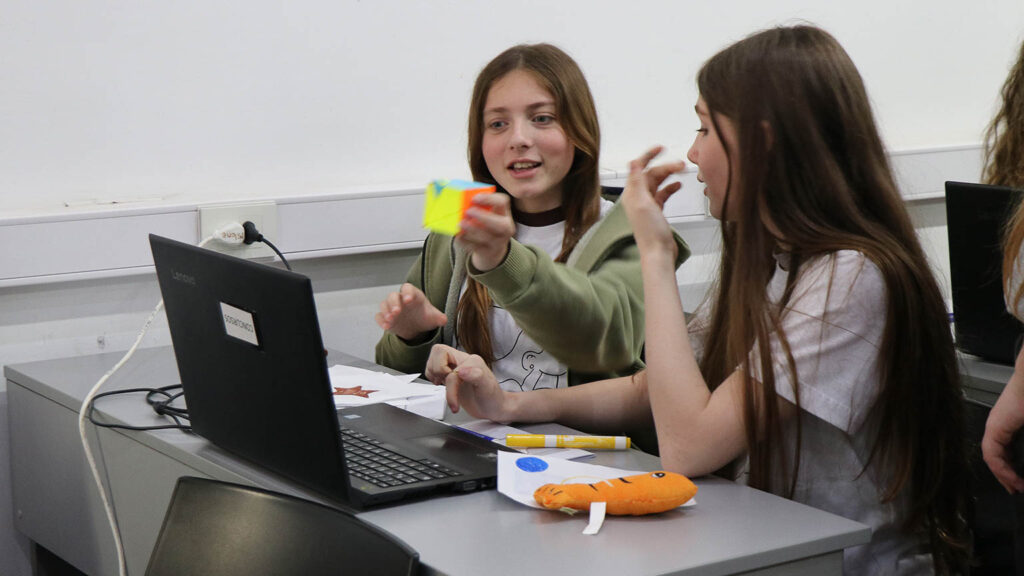
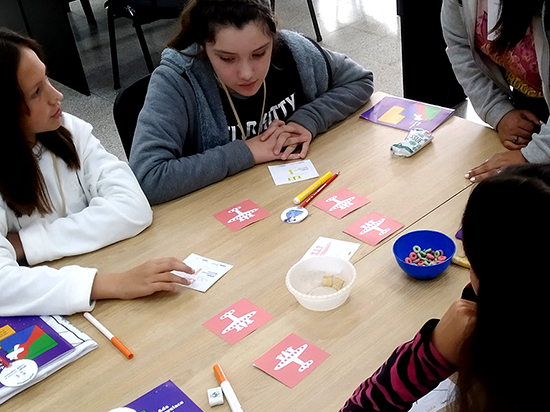
In this workshop we explore how Netflix recommends a movie or series to us. Through a game with cards, the participants organize information, detect patterns in the data we generate as users and build their own recommendation system. Then they compete with the real Netflix algorithm and, in the end, use it to predict whether they will like titles they have not yet seen.

What are we going to do?

  • Rate movies or series according to their preferences
  • Compare their choices with those of other classmates
  • Organize the information in data tables
  • Detect patterns in the group’s choices
  • Simulate a recommendation system
    Test their results against other groups

What is learned?

  • How recommendation algorithms work
  • Use of data to make decisions
  • Identification of patterns and relationships
  • Construction and reading of tables
  • Critical thinking about digital platforms

Resources

Information for host sites:
To download the materials, host sites must log in

Are you interested in this activity?

If you want to implement this proposal in your educational institution, write to us to receive guidance and the complete material: worksheets, step-by-step guide and video tutorial.

You can also register as a host site and be part of this network that grows every year throughout Latin America!

Work team

extraPola FIQ-UNL

Department of Mathematics. Faculty of Chemical Engineering.
Universidad Nacional del Litoral. Santa Fe, Argentina.

Itatí Zocola
Bachelor in Applied Mathematics. Doctoral fellow in Mathematics at CONICET. Teacher at the Department of Mathematics (FIQ-UNL). She researches stabilized methods for dominant advection problems. Part of extraPola, she takes part in mathematics outreach and extension projects with a gender perspective.

Pablo Quijano

Marcelo Actis
PhD in Mathematics (UNL). Assistant Professor at the Department of Mathematics of the Faculty of Chemical Engineering at UNL. Assistant Researcher at CONICET.

Ana de Orellana

Brenda Rivera
Bachelor in Visual Communication Design (FADU-UNL). Student at the 42 Madrid school, Fundación Telefónica. Part of extraPola, a mathematics outreach collective (FIQ-UNL). Passionate about the intersection between technology, design and scientific communication.

Andrea Bergesio
PhD from UBA, Mathematical Sciences area. Assistant Professor at the Department of Mathematics of the Faculty of Chemical Engineering at UNL.

What do you see when you see?

Mathematics and physics

Area

Physics

Age

10 to 12 years

Duration

60 min.

Participants

30 to 35 girls

WHAT IT IS ABOUT

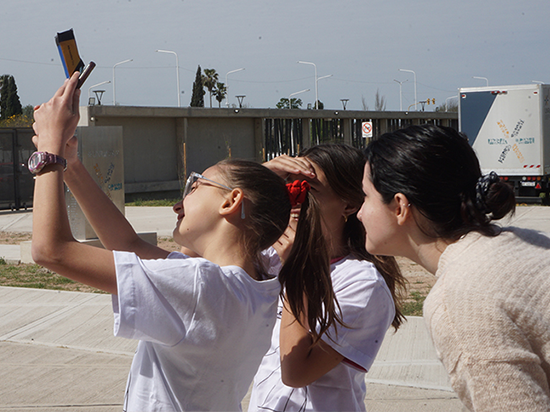
Discover how light transforms into colors

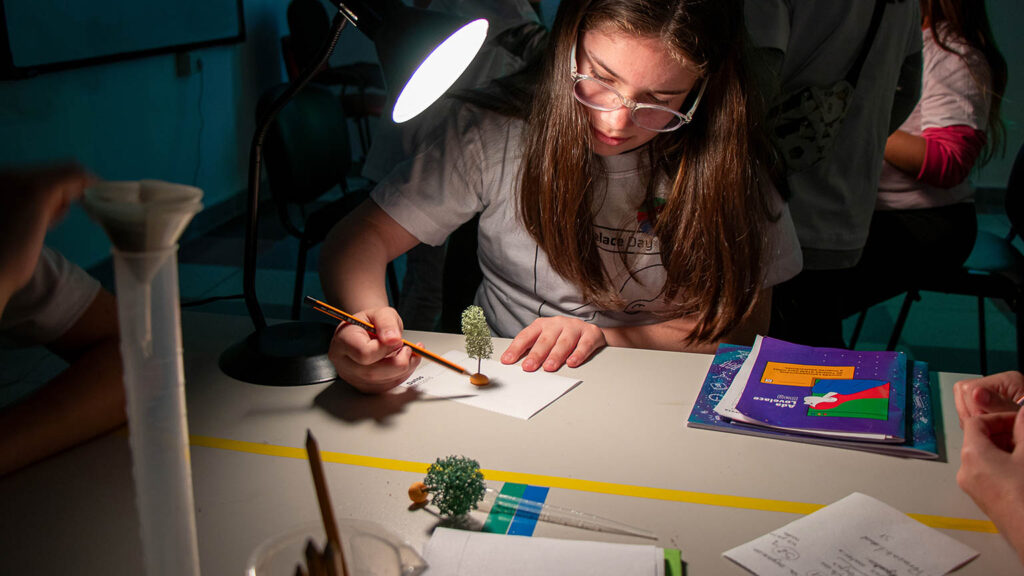
In this activity, the girls explore what light is and how it is formed by different electromagnetic waves. Through the observation of a prism or a compact disc, they discover how white light can be broken down into different colors, as happens in a rainbow. Then, they build a homemade spectroscope to investigate how this phenomenon works and learn to observe light in a different way.

What are we going to do?

  • Observe how light is broken down.
  • Experiment with prisms and compact discs.
    Identify colors of the visible spectrum.
  • Build a homemade spectroscope.
  • Analyze different light sources.

What is learned?

  • What an electromagnetic wave is.
  • How white light is formed.
  • What the visible spectrum is.
  • How a spectroscope works.
  • How to observe light scientifically.

Resources

Information for host sites:
To download the materials, host sites must log in

Are you interested in this activity?

If you want to implement this proposal in your educational institution, write to us to receive guidance and the complete material: worksheets, step-by-step guide and video tutorial.

You can also register as a host site and be part of this network that grows every year throughout Latin America!

Work team

Jorge Luis Navarro
Bachelor in Physics (Universidad Distrital, Bogotá Colombia), PhD in Physics (UNR), Master in Biomedical Engineering (UNER), student of the master’s degree in university teaching at FHUC UNL. Teaching researcher at the Physics department of the FIQ UNL since 2018.

Brenda Rivera
Bachelor in Visual Communication Design (FADU-UNL). Student at the 42 Madrid school, Fundación Telefónica. Part of extraPola, a mathematics outreach collective (FIQ-UNL). Passionate about the intersection between technology, design and scientific communication.

María Cecilia Bertero
Specialist in Didactics of Mathematics (FHUC – UNL). Professor of Mathematics (FHUC – UNL). Teacher at UNRaf, UCSE – DAR and ISP N°2 (Rafaela). Head of the Mathematics and Statistics area of the Faculty of Technologies and Innovation for Development at Universidad Nacional de Rafaela. CONICET fellow (PhD in Education in Experimental Sciences FBCB – UNL).

Ana María Falchini
Construction Engineer (UTN -FRSF). International Postgraduate in “City and Municipality” (EPOCA – Universidad de Firenze and Universidad Carlos III). Former teacher at UTN-FRR. Participant in the Mathematics and Statistics area of the Faculty of Technologies and Innovation for Development at Universidad Nacional de Rafaela, through the execution of Community Articulation Projects.

Emilio Moscardo
Bioengineer (UNER). Master in Occupational Risk Prevention. Master in Big Data and e-health. Professor in the “Bachelor in Technology Management”, in the “Bachelor in Automation and Robotics” and Postgraduate in “Artificial Intelligence and Organizational Transformation” (UNRAF). Professor in Clinical Engineering Management (UNAJ). Professor in the Bachelor of Safety and Hygiene (ITEC).

Leandro Sarmiento

Aeronautical engineers for a day

Mathematics and physics

Area

Statistics

Age

10 to 12 years

Duration

60 min.

Participants

30 to 35 girls

WHAT IT IS ABOUT

Design and test airplanes like an aeronautical engineer.

In this activity, the girls explore how aeronautical engineers work through the design and testing of paper airplanes. From observation, comparison and data recording, they discover which characteristics influence flight and how small changes can modify the results. In this way, they learn to analyze information and make decisions based on evidence.

What are we going to do?

  • Build paper airplanes.
  • Test different flight designs.
  • Measure distances and results.
  • Compare which airplanes fly better.
  • Record data and draw conclusions.

What is learned?

  • How an aeronautical engineer works.
  • The importance of observing and measuring.
  • How to compare results with data.
  • That small changes modify the flight.
  • How to make decisions with evidence.

Resources

Information for host sites:
To download the materials, host sites must log in

Are you interested in this activity?

If you want to implement this proposal in your educational institution, write to us to receive guidance and the complete material: worksheets, step-by-step guide and video tutorial.

You can also register as a host site and be part of this network that grows every year throughout Latin America!

Work team

Mariela Sued
PhD in Mathematics from the National Institute of Pure and Applied Mathematics (Brazil). Associate Professor at the Faculty of Exact and Natural Sciences (UBA) and Associate Professor at Universidad de San Andrés. Independent Researcher at CONICET.

Constanza Sánchez de la Vega
Guillermo Solovey.