Training Arboris Vol. I

Science and environment

Área

Química

Edad

10 a 12 años

Duración

60 min.

Cantidad

30 a 35 niñas

DE QUÉ SE TRATA

¿Cómo plantar y cuidar árboles en la ciudad?

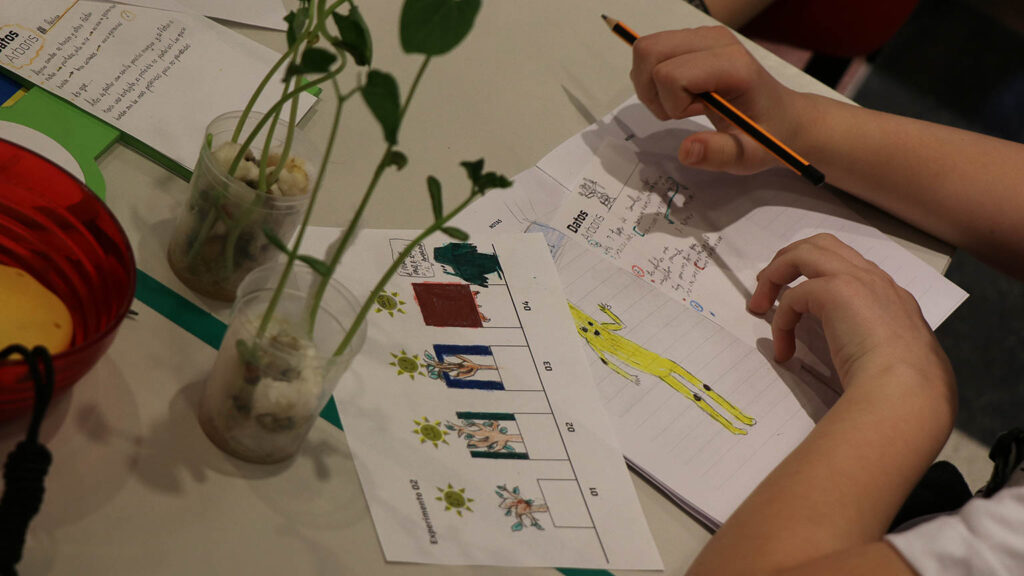
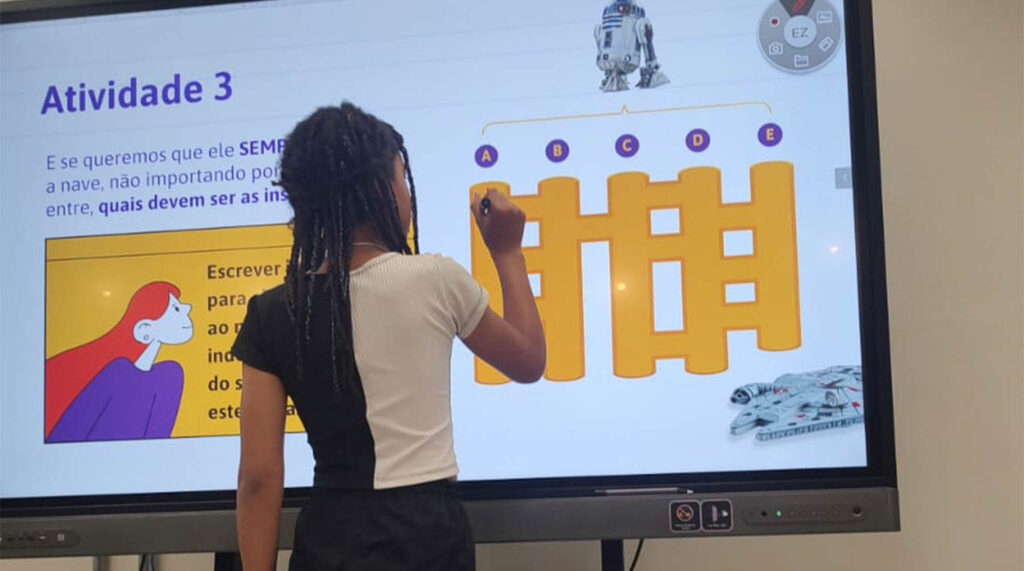
En esta actividad, las niñas ayudan a Arboris, un robot social, a aprender cómo plantar y cuidar árboles nativos en la ciudad. A partir de preguntas, experimentos y observaciones, descubren qué necesitan las plantas para crecer: agua, luz y buenos nutrientes en el suelo. Luego, con esa información, construyen instrucciones para entrenar a Arboris y enseñarle a tomar buenas decisiones.

¿Qué vamos a hacer?

  • Resolver desafíos para entrenar a Arboris.
  • Hacer experimentos con agua, luz y suelo.
  • Observar cómo crecen las plantas.
  • Registrar y ordenar datos importantes.
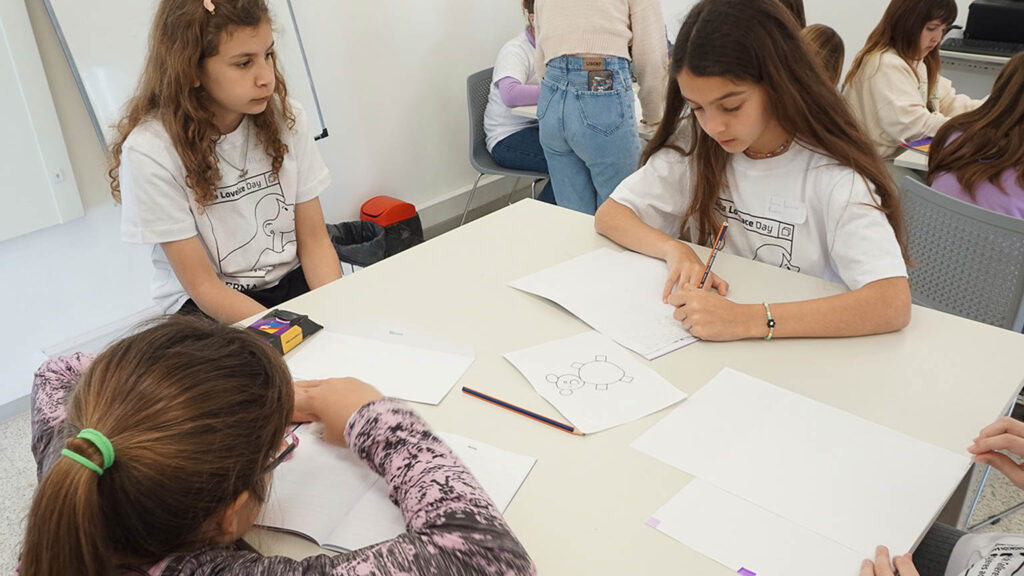
  • Crear instrucciones claras para el robot.

¿Qué se aprende?

  • Qué es la inteligencia artificial.
  • Cómo se entrena una IA con datos.
  • La importancia de dar instrucciones claras.
  • Qué necesitan los árboles para crecer.
  • Cómo resolver problemas paso a paso.

Recursos

Información para las sedes:
Para descargar los materiales, las sedes deben iniciar sesión

¿Te interesa esta actividad?

Si querés implementar esta propuesta en tu institución educativa, escribinos para recibir asesoramiento y el material completo: fichas de trabajo, guía paso a paso y video tutorial.

¡También podés registrarte como sede y formar parte de esta red que crece cada año en toda Latinoamérica!

Equipo de trabajo

Romina Biotti
También conocida como GaBiOTa. Profesora de Química (FIQ-UNL), Especialista en Educación en Ciencias Naturales (Univ. de San Andrés) y estudiante de la Maestría en Docencia Universitaria (FHUC-UNL). Juega con tierra en el Laboratorio de Química Vegetal y del Suelo (FIQ-UNL). Docente del Laboratorio de Ciencias en la Escuela Primaria UNL, un espacio creativo donde niñas y niños aprenden ciencias de forma lúdica y experimental. Apasionada por sembrar vocaciones científicas en niñas y adolescentes a través de la química, la tecnología y la divulgación.

Eve Araujo Sola
Licenciada en Biodiversidad (FHUC-UNL) y estudiante del Doctorado en Ciencias Biológicas (FBCB-UNL). Chica FIQ (UNL), JTP en el Laboratorio de Microbiología. Fascinada por la vida en toda su diversidad, de lo invisible a lo imponente. Guiada por la curiosidad, mi misión es contagiar el amor por la ciencia y la naturaleza a niñas y adolescentes, aunque los ivirás pitá aún no me han agradecido.

Brenda Rivera
Licenciada en Diseño de la Comunicación Visual (FADU-UNL). Estudiante de la escuela 42 Madrid, Fundación Telefónica. Forma parte de extraPola, colectivo de divulgación matemática (FIQ-UNL). Apasionada por la intersección entre tecnología, diseño y comunicación científica.
How dense these liquids are!

Science and environment

Area

Chemistry

Age

10 to 12 years

Duration

60 min.

Participants

30 to 35 girls

WHAT IT IS ABOUT

Discover why some liquids mix and others do not.

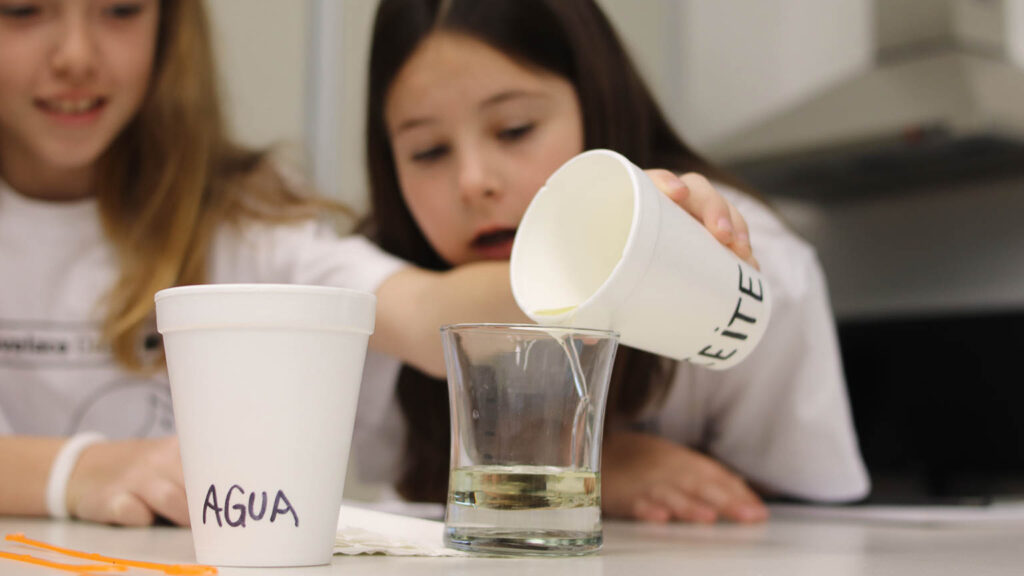
In this activity, the girls experiment with water, oil and alcohol to observe what happens when they are combined. Through the comparison between mass and volume, they discover that each substance has a different density and that this influences how they arrange themselves or mix. They also analyze how these results change when modifying quantities or combinations of liquids.

What are we going to do?

  • Mix water, oil and alcohol.
  • Observe which liquids separate.
  • Compare which liquid weighs more.
  • Test changes in the mixtures.
  • Discover what density is.

What is learned?

  • What density is.
  • How mass and volume are related.
  • Why some liquids do not mix.
  • How mixtures change when varying quantities.
  • How to observe phenomena scientifically.

Resources

Information for host sites:
To download the materials, host sites must log in

Are you interested in this activity?

If you want to implement this proposal in your educational institution, write to us to receive guidance and the complete material: worksheets, step-by-step guide and video tutorial.

You can also register as a host site and be part of this network that grows every year throughout Latin America!

Equipo de trabajo

María Cecilia Bertero
Specialist in Didactics of Mathematics (FHUC – UNL). Professor of Mathematics (FHUC – UNL). Teacher at UNRaf, UCSE – DAR and ISP N°2 (Rafaela). Head of the Mathematics and Statistics area of the Faculty of Technologies and Innovation for Development at Universidad Nacional de Rafaela. CONICET fellow (PhD in Education in Experimental Sciences FBCB – UNL).

Emilio Moscardo

Ana María Falchini
Construction Engineer (UTN -FRSF). International Postgraduate in “City and Municipality” (EPOCA – Universidad de Firenze and Universidad Carlos III). Former teacher at UTN-FRR. Participant in the Mathematics and Statistics area of the Faculty of Technologies and Innovation for Development at Universidad Nacional de Rafaela, through the execution of Community Articulation Projects.

Training Arboris Vol. II

Science and environment

Area

Chemistry

Age

10 to 12 years

Duration

60 min.

Participants

30 to 35 girls

WHAT IT IS ABOUT

How to care for trees in the city?

In this activity, the girls help Arboris, a social robot, to solve new challenges to learn how to plant and care for native trees. Through experiments, observation and data recording, they discover what conditions a plant needs to grow well and how that information helps to train an artificial intelligence. Then, they transform that data into clear instructions so that Arboris can make correct decisions.

What are we going to do?

  • Solve challenges with Arboris.
  • Observe how plants grow.
  • Record important data.
  • Analyze water, light and soil.
  • Create instructions for the robot.

What is learned?

  • What artificial intelligence is.
  • How an AI is trained with data.
  • The importance of observing and recording.
  • What trees need to grow.
  • How to give clear and orderly instructions.

Resources

Information for host sites:
To download the materials, host sites must log in

Are you interested in this activity?

If you want to implement this proposal in your educational institution, write to us to receive guidance and the complete material: worksheets, step-by-step guide and video tutorial.

You can also register as a host site and be part of this network that grows every year throughout Latin America!

Work team

Romina Biotti
Also known as GaBiOTa. Professor of Chemistry (FIQ-UNL), Specialist in Natural Sciences Education (Universidad de San Andrés) and Master’s student in University Teaching (FHUC-UNL). She plays with soil in the Laboratory of Plant and Soil Chemistry (FIQ-UNL). Teacher at the Science Laboratory of the UNL Primary School, a creative space where girls and boys learn science in a playful and experimental way. Passionate about sowing scientific vocations in girls and adolescents through chemistry, technology and outreach.

Eve Araujo Sola
Bachelor in Biodiversity (FHUC-UNL) and PhD student in Biological Sciences (FBCB-UNL). A FIQ girl (UNL), teaching assistant at the Microbiology Laboratory. Fascinated by life in all its diversity, from the invisible to the imposing. Guided by curiosity, my mission is to spread the love of science and nature to girls and adolescents, even though the little lizards have not thanked me yet.

Brenda Rivera
Bachelor in Visual Communication Design (FADU-UNL). Student at the 42 Madrid school, Fundación Telefónica. Part of extraPola, a mathematics outreach collective (FIQ-UNL). Passionate about the intersection between technology, design and scientific communication.